I first met Dane Cardiel at an industry event in London where most people turned up in gray slacks and business-casual sneakers. Cardiel stood out, at least superficially, due to his sense of style: rich fabrics, bold color, great spectacles. He later stood out philosophically thanks to his stances on technology, media culture, and how we talk about this industry we call "podcasting."
Cardiel founded Good Tape in late 2022 as a publication dedicated to these questions. Unlike the general trend in journalism, he also distributes print issues, the most recent of which featured a cover story with comedian and podcaster Nicole Byer and articles about emerging threats to the industry. We agree on many issues when it comes to audio, but after reading his work, it's clear that Cardiel lacks my sentimentality. This is probably a good thing.
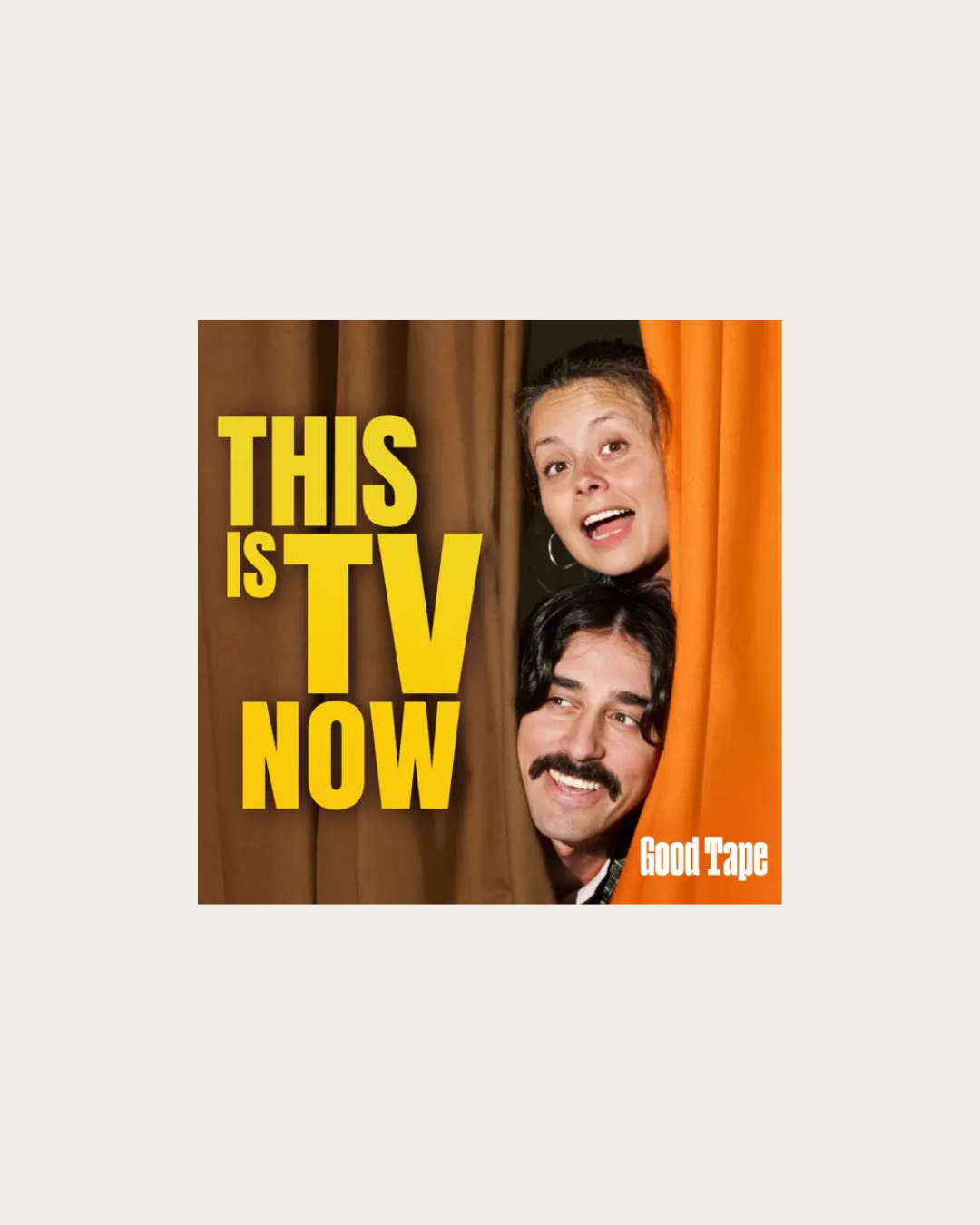
Cardiel's latest project, a video podcast with Stella Young provocatively called This Is TV Now, launched in May with the goal of bringing these conversations to wider audiences. With all that in mind, I wanted to speak to Cardiel about why he chose video, his definition of a "podcast," and, of course, the AI question. He kindly obliged early one morning in June.
Alice Florence Orr: You just launched This Is TV Now. How are you feeling after releasing two episodes?
Dane Cardiel: I’m feeling good. I’m trying to steal a little time to make the classic TikTok [video] — image graphs, me pointing at them, showing how many downloads we got in the first two episodes, and then that classic dip on episode three after the launch craze passes. I want to be transparent about the fact that starting a podcast is hard and getting an audience going is really difficult. It takes time and a lot of reps. But so far, so good.
AFO: Do you think expectations are skewed right now for people starting podcasts who’ve never done it before?
DC: They’ve always been skewed, honestly. I worked at Kickstarter for a stint in 2014, and in talking to creators about their campaigns, they always assumed they’d have a great first 24 hours. When that doesn’t happen, what does day two look like? What does day three look like? It’s the same with podcasting. The expectations are always bigger than the results. Typically.
AFO: You’ve been running Good Tape for a long time. You said when you launched This Is TV Now that you didn’t have an idea for a podcast until this one came to you. Is that a fair characterisation?
DC: Yeah. I tend to sit back unless there’s a strong idea behind the thing. There’s always been hints of podcast projects — for our first issue we recorded about thirteen hours of people answering the question “What is good tape?” and we’re sitting on really interesting material there. But I figured that’s a ten-year time capsule piece, so let it sit.
This year, and last year, there’s been such a bubbling of discontent in our industry — not necessarily frustration toward one specific source, but it feels like we’re losing the narrative plot of podcasting. Everyone is grasping for the nearest ledge, and in doing so we’re talking past each other rather than collaborating to clearly define our purpose in this medium.
A show like this is a little cheeky in its title — if someone else had made a podcast called This Is TV Now, I’d probably be annoyed at it, because ultimately it’s not TV now. But the way the discourse is going — new shiny thing, next new shiny thing — felt like the right time to grapple with that.

AFO: When we were relaunching Podcast Review, one of our campaign ideas was “your next favourite TV show might be a podcast” — a slightly more positive spin on the same idea. But it picks at something that’s quite uncomfortable: that a lot of podcasts have become cheaply made, non-unionised chat shows, now on streaming platforms that you can play on your television. Was making This Is TV Now a catharsis — did you just need to say something — or were you trying to actively affect the industry?
DC: Both, I think. With both this podcast and with Good Tape, the North Star has always been to impact the meta-narrative of podcasting within culture and entertainment. We’ve seen a sharp rise of people outside our industry who assume no one exists inside it, and that they can just mould podcasting to their likeness. It’s very colonial thinking — I’m just going to take over this ecosystem and make it my own.
AI tech founders, YouTubers, influencers, streamers — all these people have so much perceived momentum behind them. And podcasting is kind of waffling in a headspace of: we don’t know what it is, or we disagree with those people over there. The thesis behind Good Tape is that culture defines so much. Instead of approaching this from a business lexicon, we just have to define it culturally — who we profile, what we write about, the perspective we bring. And video travels much better than text these days, so having a print and digital magazine is lovely but hard. A podcast means you can be consistently on someone’s radar.
AFO: You say it’s hard to get people to read print – and yet the book industry has genuinely recovered after a significant dip. Literacy rates are still going down, but the industry itself came back, and I think a lot of that is about people now identifying as readers, and the community-based nature of books. Do you see a path forward where we can turn kids into audio consumers? Is video the only model, now that billions have been invested in turning younger generations into short-form video consumers?
DC: Matt Sayward from Platform Media had a really interesting LinkedIn post where he defined two parts of the podcast industry: the limited series and narrative content, which is more reflective, akin to the book industry; and the chat shows and celebrity content, which maps more to the magazine industry — profiles, that kind of thing. I thought that was a smart framework.
There’s also a lot of room to explore different distribution models outside of RSS. Someone with a limited series could go to Bandcamp, upload their MP3s, and say: purchase this. That’s a consumer behaviour people already understand. But the behavior podcasting has established is: this is free on this app. Until that changes, the expectation is either free or subsidised by advertising — which limited series generally can’t do.
As for young consumers: I think they’re surprising everyone with an executive title in their email signature. They’re booing commencement speakers about AI. They are almost trying to understand the expectation just so they can subvert it.
Lean-back audio experiences are absolutely viable. It’s up to us to figure out how to train them to expect that a team of people made this — and that team deserves financial support in exchange. The patronage model is on the rise. All the signals say there’s room for this. Are we experimenting enough to find what works? Probably not, because there’s so much risk in departing from the established model. But net-net it can be the same — or better.
AFO: How would you characterise the conversations on This Is TV Now so far? What are you hearing from the people you’re talking to?
DC: One of the questions that keeps coming up is which industry you define yourself in. There’s still a real hesitancy to say “I’m a podcaster” or “I’m in the podcast industry.” Everyone who’s successful in podcasting is anything but that: they’re a comedian, an actor, a filmmaker, a botanist, a sexologist. Not a podcaster. YouTubers own the word behind what they do — YouTuber, content creator, influencer, streamer. All those mediums have a very clear label. Podcasting somehow hasn’t managed that. Culturally, we haven’t done enough to say: this is a legitimate, exciting thing to put your name against. And most industry podcasts are largely not talking to people who are actually contributing to the cultural production of podcasting. They’re asking people on the business side what they think about the industry. That’s valid to a degree — but at a certain point you have to talk to the people who are actually making things, about what they’re seeing and feeling about the viability of this medium, creatively, artistically, commercially. Those are the conversations that stay interesting.
AFO: There’s been a lot of reaction to the movement into AI podcasting — from Spotify’s personalised AI podcast system to Inception Point AI’s mass-produced shows. Where do you think that conversation is going, and why are people so anxious about taking a position?
DC: I think AI is just loser behaviour, generally. You’re kind of a dork if you’re putting your weight behind AI systems to support your creative engine. There’s been a cultural shift in the last six to eight months where AI companies have essentially lost consumers and pivoted to B2B contracts. Consumers on the whole have rejected AI in their lives to the degree that it’s just become silly — and behind the silliness is something deeply problematic: the environmental impact, the data centres in poor communities affecting water conditions and air quality.
To talk about AI without acknowledging those devastating consequences is to be thinking only about your own financial success. The opportunity to make a lot of money through technology is shrinking, and AI is the next ledge people are grabbing for.
If you’re using AI to write your LinkedIn posts, you’re a loser. If you’re using AI to flood our app ecosystem with nonsense content — Jeanine Wright from Inception Point AI — you’re a loser.
I don’t think their end goal is even to continue in podcasting. I think they’re training a model to sell for a completely different purpose — AI personality technology, stuffed animals with personalities, whatever. So I try not to give those people any time of day. It’s embarrassing when people platform them at podcast conferences. Stop talking to them, stop engaging with them. They’re not ultimately relevant to what podcasting is today. And if we make them relevant, we’re doing ourselves a disservice.
AFO: This is the part where I’m supposed to push back. I’ll just say this: Someone recently told me that the majority of their listeners are on video because their show is made to be accessible to everyone, even people who are hard of hearing. Can we create a healthy definition of a “podcast” that also encompasses accessibility?
DC: For now, I do think it’s very important for a podcast to participate in what remains an open ecosystem of distribution — primarily through RSS. If Netflix were to upload video content to its platform and call that a podcast without distributing via RSS, that’s not a podcast to me. That’s a different form of cheap content used to fill an app. RSS is a fundamental component of what a podcast is, and that doesn’t mean it has to be audio or video — it just means distributing content through an open standard.
We should fight for [RSS], because it is one of the only technologies that gives creators the ability to widely distribute and actually own their audience. Without it, you’re beholden to gatekeepers at various walled gardens who can say yes or no to your content. That’s the direction Spotify and others would very much like us to be moving in. So: RSS first, build on top of that.
The Standards Project is doing important work organising around better features through RSS — the Lord’s work, really, in a world where people are trying to chip away at it every chance they get.
AFO: You’ve reflected on the last decade in the industry a couple of times today. I’ve been reflecting on that too — migrating the site, reading reviews from 2018, and finding they’ve almost all become canonical. Serial, Radiolab — these names just trip off the tongue now. I’m struggling to write about the equivalent shows today. I don’t even know what to call them. Narrative audio? Immersive audio? Are you seeing any shows that you think might be the canonical podcasts of our current era?
DC: Worth remembering that around that same golden age period, Dax Shepard’s podcast launched — audio only at the time. So right next to Floodlines, there was a celebrity chat show gaining a lot of popularity. Let’s not romanticise that window too much.
As for what’s canonical now — honestly, I’ve been in a period of wait and see more than proactively trying to define it. Who our audience is right now is a question I genuinely don’t know the answer to, which is a troubling thing to admit, because that’s the one thing you have to know when you do anything. We now have a whole new half-generation to contend with. And we’re mid-transition: Netflix, Hulu, all these streaming platforms are getting into podcast distribution.
What are the seminal works of 2025? I don’t know. I think it’s too early to say. But I do think it’s important for people with opinions to be prepared to use them — to hopefully sway us in one direction or another, before the window closes.
Thank you to Dane Cardiel for his time. Listen to This Is TV Now wherever you listen (or watch) podcasts.