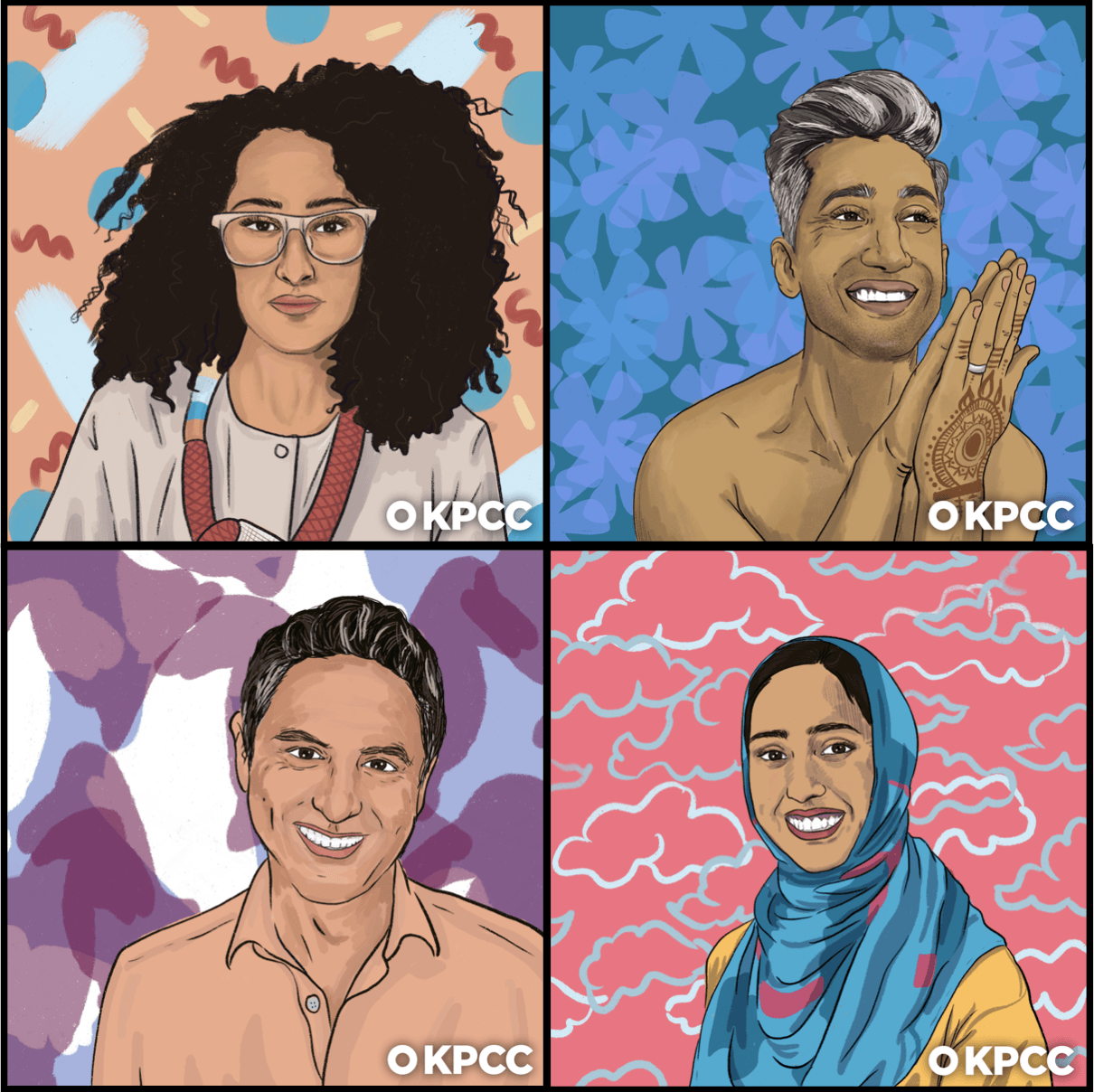
When Misha Euceph moved to the U.S. from Pakistan in 2003, being Muslim went from being an unremarkable part of her identity to the single way in which others perceived her. "The only time Muslims are ever on TV or in the news," Euceph says, "we're asked about Islamophobia, or terrorism, or our headscarfs, or praying five times a day. We're being pigeon-holed." Which is why Euceph created her latest podcast, Tell Them, I Am, as a platform for Muslim voices to talk about the small moments that have defined who they are — whether those moments intersect with their faith and heritage, or have nothing to do with either. The resulting series is a collection of intimate and touching interviews with 22 different guests including Queer Eye's Tan France, the actress Alia Shawkat, and the religious scholar Reza Aslan. All episodes of Tell Them, I Am are available now on your favorite podcast app and on KPCC's website.
I spoke with Euceph about how the podcast came together, and how she was able to get her guests to speak so candidly about their lives.
For those who haven't listened, what’s the concept behind Tell Them, I Am? Why should people listen?
Tell Them, I Am is a podcast about the small moments that define who we are and who we are not. The stories are universal, the voices are all Muslim. People should listen for the same reason they should listen to any good podcast—it’s filled with relatable, beautifully crafted stories. For those who don’t know any Muslims, this is also an opportunity to get to know 23 people intimately who happen to be Muslim.
In addition to creating Tell Them, I Am, you produced The Big One and recently published the guide How to Make a Podcast. Could you walk me through what your path has been like getting to where you are now? What brought you to podcasting in the first place?
Having grown up in Pakistan, I’ve always known the importance of creative radio—Radio Pakistan was one of the most innovative broadcasting efforts since the 1940’s. When I moved to the U.S., I became obsessed with NPR. I would apply to internships there every year in high school. I never got them obviously, because NPR doesn’t hire high schoolers. Even though it took me until I was 21 to seriously pursue radio, I think it has always been brewing beneath the surface.
Want to receive our latest podcast reviews and episode recommendations via email? Sign up here for our weekly newsletter.
I make a lot of work because if I don’t, I get depressed and anxious. I throw tantrums that my family and boyfriend have to suffer. Making work obsessively and exercising are the only two things that bring me enough peace to be a more present and loving person. A lot of the progress in my career is the result of entrepreneurial risks and other amazing people taking a chance on me. In 2016, I got a master’s degree from Northwestern and did the Transom week-long workshop. But I hadn’t made a lot of good audio. The only way to do that was to make a podcast, so I made Beginner. And in the process of making Beginner, I learned how to meet deadlines, how to sound design, how to work with other people. I also learned the business and marketing side of podcasting. To try to make Beginner full-time was an entrepreneurial move, but Arwen Nicks noticing that and deciding to hire me at KPCC was a gamble on her part. I didn’t have decades of experience or a lot of audio work out in the world when I started working at KPCC, but Arwen’s and James Kim’s trust in my voice and production skills made me better—and quickly.
Before interviewing your guests, you start each episode with a personal story. I love these sections — can you tell me why you thought to include them?
We developed this idea at NPR Story lab, where it kept coming up that listeners didn’t have a central character to root for since every episode was a different story. My team encouraged me to host and I took on the challenge. We started calling them our Sex in the City anecdotes, something that had never been done before in podcasting but really well with our goal and format. And they gave listeners the continuity that was lacking.
Tell Them, I Am features a number of rather famous interviewees. How did you go about getting these guests on your podcast — and how did you get them to speak so candidly about their lives?
We begged some of them! And we got a lot of rejections. For every person you hear on the show, there were 10 who said “no” to us, because the concept was too complicated or because we were nobodies. I was lucky enough to have Mary Knauf’s help in booking these guests in the span of 2 months. We cold emailed folks and their reps. We made our case. Not surprisingly, a lot of people wanted a chance to tell a story other than the one they’re asked about regularly. One person literally said to us, “Thank god you’re not asking about the gay Muslim thing.” To get them to speak candidly, we were candid and honest with them. We did long and extensive pre-interviews to get them to a place where they felt good about their story. By the time they came into the studio, it felt like we were old friends.
It certainly comes off that way. And the stories your guests tell, they’re in fact stories, not just simple answers to interview questions. How did you make that happen?
Having a small moment and a story around that small moment was a requirement of the podcast. We asked as many questions as we needed to (and then edited the questions out) until we got to that point. I also outlined each story before bringing the guests into the studio. Sometimes we had a couple of moments to choose from and I prodded the guests to find out which one was more impactful in the person’s life and carried more details. I was relentless in asking questions over and over again until we got enough detail to paint a beautiful story. I was also unabashed in asking about feelings.
At the end of each episode, we hear that Tell Them, I Am is made by a team of about just two to three people. How do you make the podcast sound this professional with a small team?
We are all ardent students of the craft and we all play to our strengths. We try to learn from each other every opportunity we get. And we put our egos aside for the sake of the work. No sentence, no particular voicing style, no sound design, no clip from a guest, no story angle is worth getting attached to if it is not in service of the story. We all fundamentally understand that and are willing to kill our darlings to make the stories stronger. No one wins if the story is bad. And we work really fucking hard. We were in the office every Sunday until this show came out.
Lastly, given you’re so prolific, what’s next for you?
You’ll have to stay tuned!