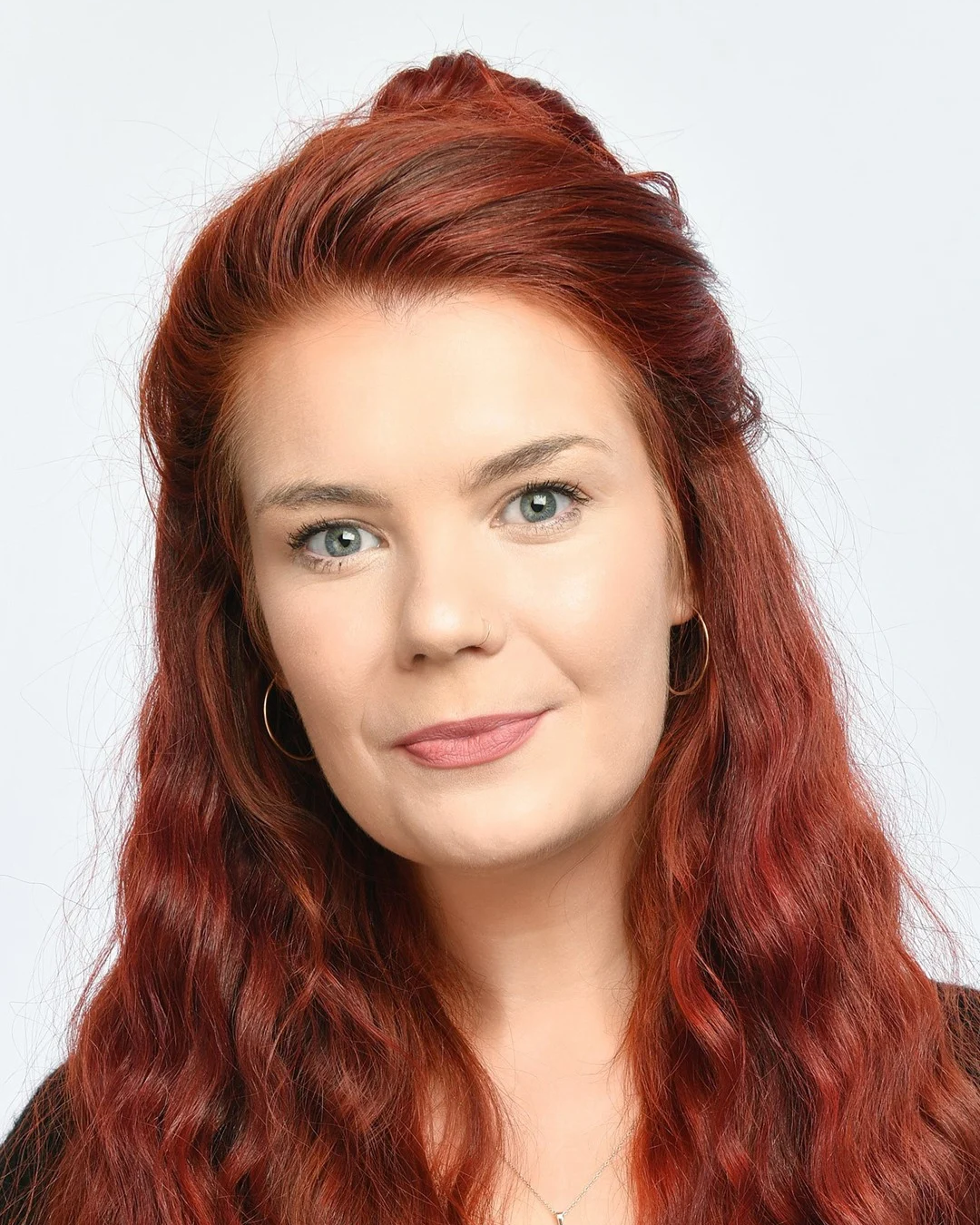
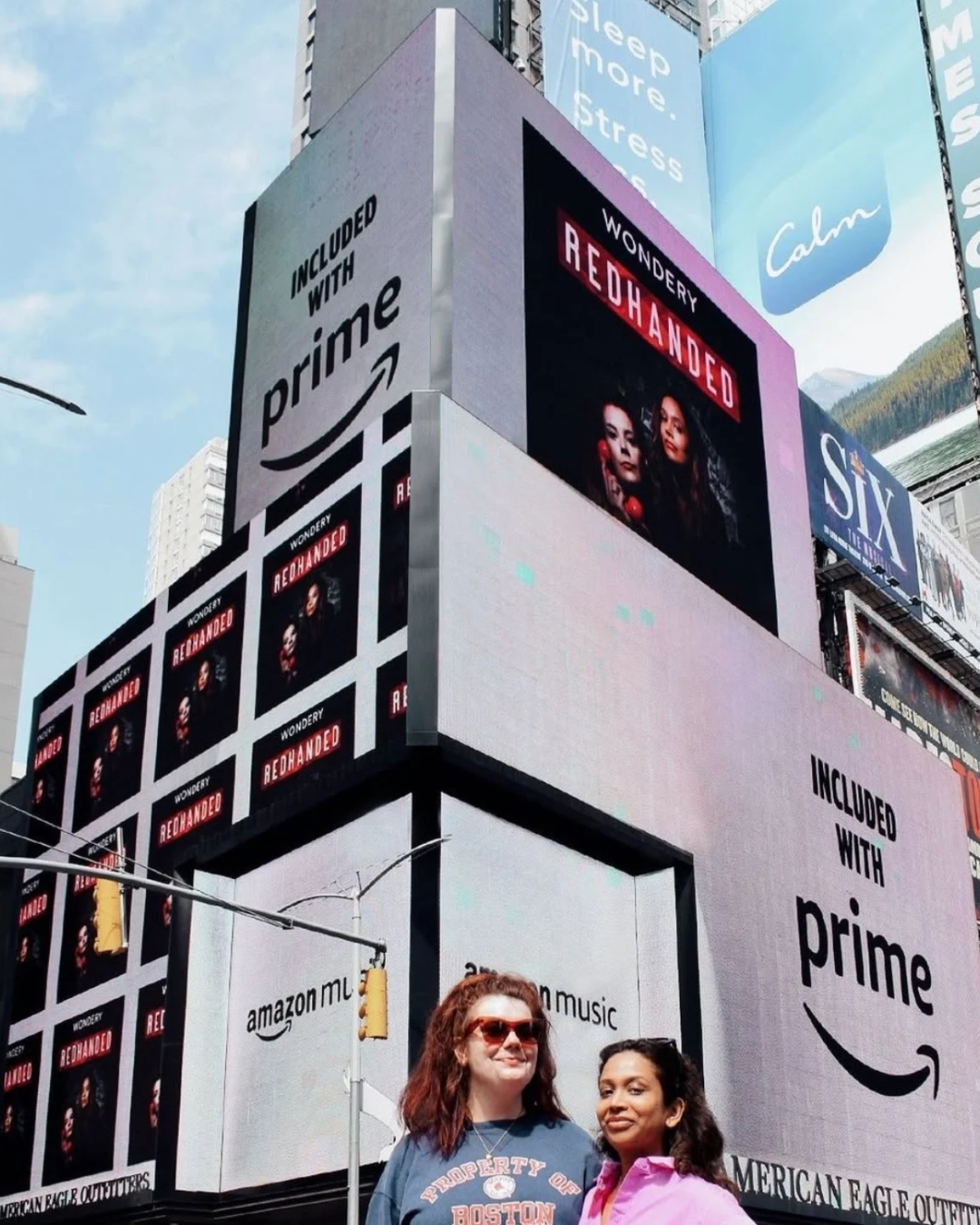
In July, RedHanded will celebrate a decade of podcasting. Hannah Maguire, who has co-hosted the hit true crime podcast with Suruthi Bala since the beginning, still can't fathom that the show exists. According to her, success was a fluke, rather than a plan that came good. It all began after a chance Thanksgiving dinner in a East London flat, after which the two hosts decided, over a lot of wine, to start a podcast.
Since then, RedHanded has grown into an eight-person company running a flagship show, a spin-off, a slate of Patreon content and limited series, and live arena tours big enough to sell out the London Palladium overnight.
We recently sat down with Maguire, who splits her time between London and Cape Town, to talk about the show's "sliding doors" origin story and the scrutiny that comes with mainstream success.
Alice Florence Orr: Let's go back to the start of RedHanded — can you tell me about how the show started?
Hannah Maguire: The fact RedHanded exists at all is miraculous. Su and I had a complete sliding-doors chance meeting — we never would have crossed paths otherwise.
I used to teach English as a foreign language in various countries, and when I came back to London after a year in Korea, I was living in a property guardianship — essentially you’re paying to squat in these unsafe buildings that would otherwise be abandoned and are waiting to be knocked down. I was living there because I had no money and couldn’t afford to live any other way. [I shared] with two guys, and a third guy who slept on the sofa for six months, paid no rent, but was really attractive, so I didn’t say anything. One of the actual tenants was American, and for some reason had a lot of his extended family — including children — to stay with us in this cramped, unsafe flat in a pretty bleak part of East London. Have you seen the cover of Oasis’s (What’s the Story) Morning Glory? That tower is where I lived. So bleak.
It was over Thanksgiving weekend, and all the Americans sleeping on air beds in this ridiculous flat, that we decided we simply must have a Thanksgiving dinner.
The guy on the sofa asked if his friend could come — she’d just got back from travelling and he was seeing her that day. I said, “Of course, attractive man, you can have whatever you want,” even though I was raging about the whole situation, and had made this massive dinner for everyone. Then Suruthi walked through the door.
She’s since told me that if she’d known [her friend] wasn’t paying rent, she wouldn’t have come, because she’d have been too embarrassed — and then none of this would be happening.
We drank quite a lot of wine, and it turned out she’d discovered podcasts while travelling, and I’d had a very similar experience in Korea. I’d listened to a lot of audiobooks as a child — there wasn’t much music played in my house, it was constant talking — so when I discovered podcasts, I couldn’t get my head around the fact that they were free and infinite. She’d been travelling, and there’s only so much music you can listen to across sixteen-hour bus journeys in Asia. Back in 2017, nobody was listening to podcasts, so finding someone who was listening, was interested in talking about them, and was listening to the same ones as me felt like an enormous moment — which we didn’t know then, but was.
We decided that night to start a podcast together – and we did.
AFO: You and Suruthi have covered many of today’s most controversial stories, such as the Luigi Mangione case. How do you research these topics when there is so much noise and misinformation on social media?
HM: Most recently we covered Lindsay Clancy, which I think is a perfect example of this issue, because true crime has a sort of grubby reputation for various reasons [. . .] But it’s been such a publicised trial, and there are so many emotions at play, that it’s impossible to engage with a case like that on a non-emotional level — if you can, I have questions about you.
People say the most furious things online, which has always happened, but now you can say it to millions of people in a second and it becomes the truth. So what we take very seriously at RedHanded is: if it’s not true, we won’t say it. And we won’t apologise for jokes, and we won’t apologise for opinions. If we get something wrong, we’ll correct it and apologize.
What really makes me laugh is the comments we sometimes get along the lines of, “you can’t just say your opinion like it’s fact” — and I’m like, I’m telling you what I think and you’re allowed to disagree with it, that’s fine. But it is concerning that because of where we are in the evolution of media as a global society, whatever video gets the most shares becomes true – even if it’s not.
AFO: Why do you think people think true crime is "grubby"?
HM: Most true crime is hosted by women, and people don’t like us. It’s an easy thing to turn your nose up at, especially when it makes more money than you and has more listeners than you.
AFO: People inevitably come to an episode with zero context and jump to conclusions — how do you and the team handle those tougher moments?
HM: It used to really upset me. For a good few years I didn’t read comments at all because it was so difficult not to take it personally. But what’s nice about making so much content is that you don’t really have time to dwell on things — you have to move on, because there’s another show to do next week, and the internet has a short memory; it will end. Because we’ve been a weekly show from the start — I don’t think we’ve ever missed a week in nine years — it’s a statistical impossibility that everybody’s going to agree with everything we say. That can’t happen.
What really changed the way I thought about it was two things. First: even if you consume every second of the content I make, which is unlikely, I take up maybe three hours of your week — and if I can piss you off that much in three hours, I’ve got quite a lot of power over you, and that’s fine.
Second, and this is maybe less manipulative: I am myself on the show – it isn’t a character – but they don’t know all of me, so I can’t respond with my whole self to something that’s only been said about a fraction of me. That doesn’t make any sense.
It’s not always easy, but that’s definitely helped me realise it really doesn’t matter. I’ve got friends who work at the Ministry of Defence, doing real jobs — [RedHanded] a podcast. It’s a radio show on the internet. It’s not that deep.
AFO: Is there a case you’re especially proud of, even if the subject matter itself was tragic?
HM: I wrote a two-parter on the assassination of JFK and I really wish I hadn’t, because now I’ve seen behind the curtain: it was the CIA, and they did it because he was going to pull out of Vietnam.
I know how that sounds, I sound mental, but it’s true. The longer I talk about it, the more mad I sound, and that’s exactly how they want it. I’m actually writing a follow-up on the assassination of Bobby Kennedy right now — maybe that’s why it’s at the front of my mind — but when I was writing the JFK one, I genuinely thought, I’ve ruined my life. It’s all orchestrated by arms companies. Our whole lives are a joke.
AFO: Does broadcasting an episode like that — not knowing who’s listening — ever make you anxious or paranoid?
HM: No. I think people who are going to become the Unabomber are going to find a way to do it regardless. No person who’s well-adjusted, with nothing else going on, listens to “I Don’t Like Mondays” and shoots up a school — that’s not the thing. We love to do that, to blame video games or music, but every single time we’ve picked a new thing to blame, it’s been studied and found not to be true. So I’m never going to sensationalise anything, or make it sound like a good idea. I don’t concern myself with whether it’s responsible — I think being factual is the most responsible thing you can be.
AFO: Do you ever worry the CIA itself might be paying attention?
HM: Either way, the train’s left the station on that one — there’s nothing I can do. I think that’s actually how I concluded the JFK series: don’t worry about it, it’s completely out of your hands. It wouldn’t be much of a true crime show if I was lying, so I never lead people astray. And I think mistrust in governments has a lot more to do with governments than it does with me.
AFO: You’ve taken the show from a passion project to running an eight-person company — how has the industry changed over the decade?
HM: We learned quite early on that anticipating anything is a waste of time, because it all changes at the drop of a hat — you can’t predict what’s going to happen. And just by the nature of being in the content creation industry, we haven’t seen a whole life cycle yet. People are just starting to sell their YouTube channels, and I’m sure RSS feeds will be next, but we don’t know what happens when content creators stop creating — what that retirement plan looks like — because nobody’s done it yet, there hasn’t been enough time.
Su and I are very different, which is part of why the show works. She’s a real forward planner — five, ten, fifteen-year plans — and I’m just, I want to have a good time now. My life is not a waiting room. Let’s buy a villa in the Maldives. So she’d probably give you a different perspective to me.
But I think people like to say podcasting is a saturated market, and that’s actually totally untrue. Ofcom included podcasting in their report for the first time last year, and found that only one in eight people in the UK has ever listened to a podcast. So there’s this enormous untapped market, but people still talk about it like it’s impossible to break into. The barrier to entry is higher than it was ten years ago — that’s true, because everything looks very slick and video now, or at least seems to. Platforms are pushing their video branches because they can sell more ads off video, so we all think it has to be like that, and I suppose at the level we’re at, you kind of have to be, to compete. But not everyone needs to be thinking in terms of distribution deals and competition.
It changes all the time, but I think the only prediction I’d make is that with the move to video, and with every platform trying to take on YouTube — which they won’t be able to do, I don’t think, but that won’t stop them trying — it’ll all become one big conglomerate thing: podcasting, content creation, TikTok, every type of content will just become one thing, and I think it’ll probably be YouTube.
AFO: You have hosted several sold-out live shows, too — what are those like?
HM: It’s the only thing I’ve ever wanted, it’s amazing. I’d live on the road if I could. Even though we’ve got a team now, making the podcast is quite an insular experience, and people consume podcasts passively — you listen while driving, or cleaning the house, whatever — it’s rare that people actually sit down to listen, and rare that they listen together.
But when you do a massive live show — the biggest we’ve done was the Palladium, over three thousand people, which we sold out overnight, years ago now — you think, wow, there’s all these people who’ve got lives and jobs and cars and things to worry about on the way home, and they’re all here to see our work. That’s something I never thought I’d experience.
Live podcasts are difficult, because we’re not an interview show — it’s not a famous person talking to another famous person about being famous, you can do that and sell out the Albert Hall, no problem, it’s not a particularly different endeavour to your weekly show. Ours is trickier. I’ll just say our live shows are the best out there in the true crime space, because we work really hard on them. We pick one story, and we’ve always felt there has to be a reason to come out and spend forty quid when you could just listen to a story at home. It has to be something bigger than that. So we’ve done maybe five or six tour shows, with a lot of video involved — it’s not just us telling a story, there are a lot of additional layers.
I think it’s quite common for podcast fans to go to a live show and be disappointed, to the point they never listen again. That’s the worst possible scenario for a live show, so we’re always conscious of that. It still happens — people come and don’t like it, you can’t please everyone — but we work very hard on creating a show that feels like an episode of RedHanded, but was worth leaving the house for.
AFO: Why do you think so many podcasts get live shows wrong?
HM: I think it comes down to what I was saying about listening to a podcast being passive. At a live show, you’re not doing anything else, you’re only watching the person in front of you, you don’t have something else going on — I think that’s a big part of it. And as a creator, trying to fill that gap in a medium that isn’t your bread and butter is really difficult. Even if you’re a video-forward show, it’s still different, it’s just a totally different skill. But it can be done.
AFO: Can you tell us about any upcoming projects your fans should look out for?
HM: No miniseries in the immediate future — the most recent one we did was Flesh and Code. We released it and then two weeks later Wondery collapsed, so it was kind of the show that never was. We spent two years of our lives making it, and it’s a wonderful show.
Thanks to Hannah Maguire for taking the time to talk to us. The Bobby Kennedy episode of RedHanded lands on November 12th. Listen to RedHanded on Apple Podcasts, Spotify, or wherever you get your podcasts.