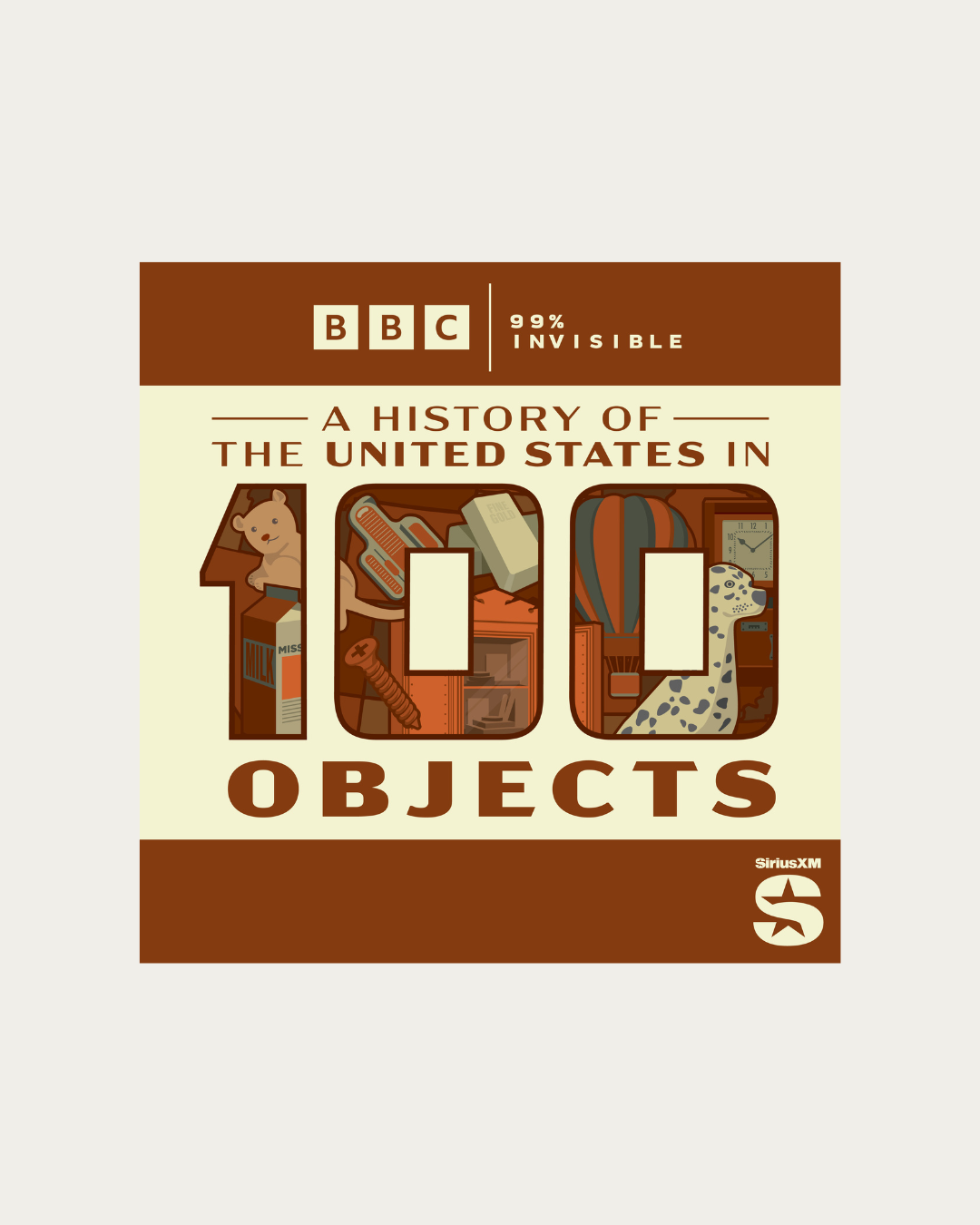
Just after the BBC wrapped up the first run of their ambitious and critically-acclaimed series charting the history of the world is a hundred objects, 99% Invisible, created and produced by Roman Mars, was publishing its first episode on the other side of the Atlantic. Both radio shows use tactile visual forms as a lens to interrogate our world, so it seems somewhat inevitable that, sixteen years later, the teams are working together on a new project.
Writing in 2020, Aaron Yost described listening to an episode of 99% Invisible as "always a little magical."
This is narrative, journalistic podcasting like you’ve certainly heard on other programs, but is always delivered with substantial takeaways that you’re bound to think about weeks and even years later.
Originally a collaboration between San Francisco public radio station KALW and the American Institute of Architects in San Francisco, 99% Invisible was purchased by SiriusXM in 2021. While still producing the core show, Mars is now working with the BBC to produce a new version of the BBC's popular series, using objects to tell the story of the United States and mark the 250th anniversary of the country's founding.
We chatted to Mars about the series, and historical storytelling in general, to find out how taking on a task like shaping a country’s narrative though objects can unlock fresh creative possibilities. His interest in mass produced items as representations of the American story felt Warholian, and his passion for the personal stories behind many apparently innocuous objects presented like a manifesto for his form of audio storytelling. We hope you enjoy the conversation.
Alice Florence Orr: Your new project, A History of the United States in 100 Objects, is the first co-production you’ve done with the BBC. Tell me more.
Roman Mars: First co-production, for sure. I’ve worked with different BBC folks over the years in different ways, but never quite like this. I’ve been really impressed by the whole organisation. Such pros – and just adorable.
I started in radio at KALW in San Francisco. All the stations here are independent and they cobbled together different feeds and shows, and KALW was always kind of the "BBC station." It [broadcast] a lot of BBC content overnight and in the morning; in the breaks, we'd feed BBC news rather than NPR news in a lot of the hours. So I have a close affinity to the stuff the BBC makes.
AFO: Did the BBC approach you about the project, or did you approach them?
RM: They approached me. They’d done the original A History of the World in 100 Objects, it was a huge success, and they were casting about for what it would look like to do an update tied to the 250th anniversary of the US.
To their great credit, they said: "well, who are we to say what is important in American history?" They were looking for partners in the States who could add expertise and confidence to the choices they were making. They reached out to me, and I was already in love with the first series — it started the same year 99% Invisible started, and the approach felt similar: looking at things whose importance you might miss when you first encounter them. As soon as we came into the project, I think the 99% Invisible approach started to influence what [objects] we were choosing.
AFO: Many podcasters have done projects to mark the 250th. Was marking this anniversary something you aimed for?
RM: It was more that everything came together and made sense. I tend to be a little allergic to date-peg anniversaries. My natural approach is: it’s an interesting story regardless of the timing.
But this is a moment when people are looking for things, a moment to be reflective and take stock. It serves its purpose for our lens. I just don’t have a natural yen to be doing anniversary work all the time.
AFO: When someone puts parameters on your creativity that you wouldn’t give yourself, you can really surprise yourself with what comes out.
RM: I think that’s right. The object lens really does help focus the mind — if you’re just saying “I’m going to tell 100 stories about US history,” the field is too wide open. And having the moment of reflection gives you a little room to offer an essay about things, rather than just sticking to the story. The constraint gives you a kind of freedom.
Constraint gives you a kind of freedom.
AFO: I was reflecting on America’s great "public service" historians — the likes of Ken Burns — whose documentaries are so often told through the lens of individual people. How does telling history through objects compare, and does this constraint help you better understand America at this point in its history?
RM: Pretty often, we’ll definitely use the object to get to a person. But the object lets you skip around different people and come together on a thesis; a big idea. We knew we wanted to differentiate ourselves from the original series — not focusing on priceless museum items, but on overlooked and mass-produced things that reflect the United States as a country of production and bigness.
The first major object is a six-degree angled screw. Billions have probably been made. You wouldn’t put it in a museum. But through [the screw], you can tell the story of all these different people moving in and out of history, and ask: "what does this say about America?" The smallness of the object and the bigness of the effect is immediately evocative to me.
I always wanted the series to have a joyfulness, even when we’re covering heavy topics — racism, slavery. The curiosity and discovery should feel joyful even when we’re getting to difficult things. So far, we’ve been really proud of what we’ve achieved in terms of that tone.
AFO: I’m interested in your curation process. How do you find the objects? And once you’ve chosen one, how do you build the episode around it — find the testimonials, focus the lens, and then expand it out into wider context?
RM: Like most things, it starts with us and our own curiosity. I’m an avid reader, and I’m often drawn to the tiny thing mentioned on page 300 that most people miss.
I read Daniel Immerwahr’s How to Hide an Empire and thought about that screw for years — it was the first object in my head when we started pitching.
My wife read a section of an Imani Perry book that mentioned the Blue Back Speller and told me about it. These things happen organically. And with a task this daunting, whatever motivates you to get it done is enough — it’s usually a producer’s curiosity really pushing it forward.
Once those things start to form, you check: "does it deliver a compelling story with enough twists and surprises? What’s the big idea? What does it say about America?" And then at a higher level: does the constellation of choices encapsulate enough of the country — enough geographies, enough eras? Right now I’m reading about coal mining because I need to find an object somewhere in the history of labor struggles. Maybe it’ll pan out. Maybe it won’t.
AFO: Sometimes the object creates the story; sometimes you have to find an object to represent the story you want to tell.
RM: It definitely goes both ways. Sometimes the object really presents itself. Sometimes it’s about whether this thing spans enough of the history to justify an episode. Papers and books are technically objects, but they’re also just… history. So we try to find more unexpected ways in. The constraint makes the process interesting — it brings out different things in the story. It’s really nice when the object is a tchotchke or a thrown-away thing.
AFO: That’s lovely. Do you seek out objects that are particularly tricky — lost, or palimpsestic; added to over time?
RM: The original BBC series really relied on the object’s look and feel because so much of what they covered was before recorded history. We’re well into recorded history, so everything leads to a story much faster, and the interplay between the object and the story is more fluid.
One episode I was really interested in was the sharpened screwdriver — which is an imaginary object, one that doesn’t exist. It was talked about a lot in the Bernhard Goetz case, the 1984 subway vigilante shooting in New York, and it was a way to talk about how important this object was in people’s imaginations, even though it was only ever in their imaginations. The two historians I spoke to, who had both written books about the case, hadn’t made it the centrepiece of their analysis. But as soon as I presented the idea to them, both immediately said: absolutely, I can tell that story through this imaginary object. So yes — the objects can be tricky, and sometimes they don’t even need to exist to serve their purpose.
AFO: Has there been an object that’s been the biggest surprise — one that opened up a story you had no idea you were going to get to?
RM: All of them have been surprising and fun for me. It’s strange to be this far into my career and find myself genuinely in love with my show in a new way. But the one that really sticks with me is the Otis pamphlet — our seventh episode. We were looking for something Revolutionary War-era tied to the actual anniversary date, and I was worried we weren’t going to find anything that felt fresh. I’m so tired of that history being told over and over again. Then Jack Hitt pitched this pamphlet that is essentially the Declaration of Independence before the Declaration of Independence — a declaration of ideals before there was any notion that independence was how those ideals would be achieved. And the tragedy of the man who wrote it, his rise and fall — that one really sticks with me.
The other one I’m very excited about is coming up: a poet named Sarah K has these beaded moccasins that were gifted to her grandmother. Her grandmother was Japanese American, interned during World War II, and one of the ways she secured her release was through education — she was sponsored by a church and sent to teach at a school for Native American girls. These were schools explicitly designed to strip those children of their culture and assimilate them into American life. And yet she was genuinely beloved by her students, who gifted her the moccasins.
All these complicated and troubling threads coming together in one object: the harm done to her because of her race, and the harm the system she was part of was doing to others. That’s the kind of history I get really excited about. It can’t be rah-rah America 250th anniversary. It has to be a real reckoning — and a recognition that there’s real strength and pride to be derived from facing that honestly. Each of those things represents a kind of failing, and moving past them represents progress. And if you don’t want your country to be better, to have more rights delivered to your children than you have — I don’t know what more you could want from America.
AFO: Why is audio the right medium for this kind of storytelling?
RM: When you tell a story about an object without having to see it, you can fall in love with it without prejudging what it looks like. An 18th-century pamphlet with the old typography — the Ss that look like Fs — you see it and you’re immediately distanced. But when you’re carried inside Jack Hitt’s discovery of it through his voice, it’s just so much more effective. You get the sense of people’s passion, and none of the prejudice of your own visual associations. You don’t get the reenactors who don’t look enough like Washington. I just find history is much better told in audio and in books — you get people’s passion in a pure way.
I’m biased, because it’s literally all I do. But I’m also an avid audiobook listener, a podcast listener, a radio devotee. I just think it’s superior in every way.
AFO: You’re preaching to the converted. Though I think you have to make that argument a little more often now.
RM: You do. We get asked about a video version, and there might be short clips we could do. But I honestly can’t do my job on video. Documentary is not made for that. If you’re making a chat show, there’s something to be gained — faces and countenance convey something meaningful, and I get that connection. I’m just so much more connected to voices. Always have been.
Thank you to Roman Mars and the BBC. You can subscribe to A History of the United States in 100 Objects on Apple Podcasts or wherever you listen.